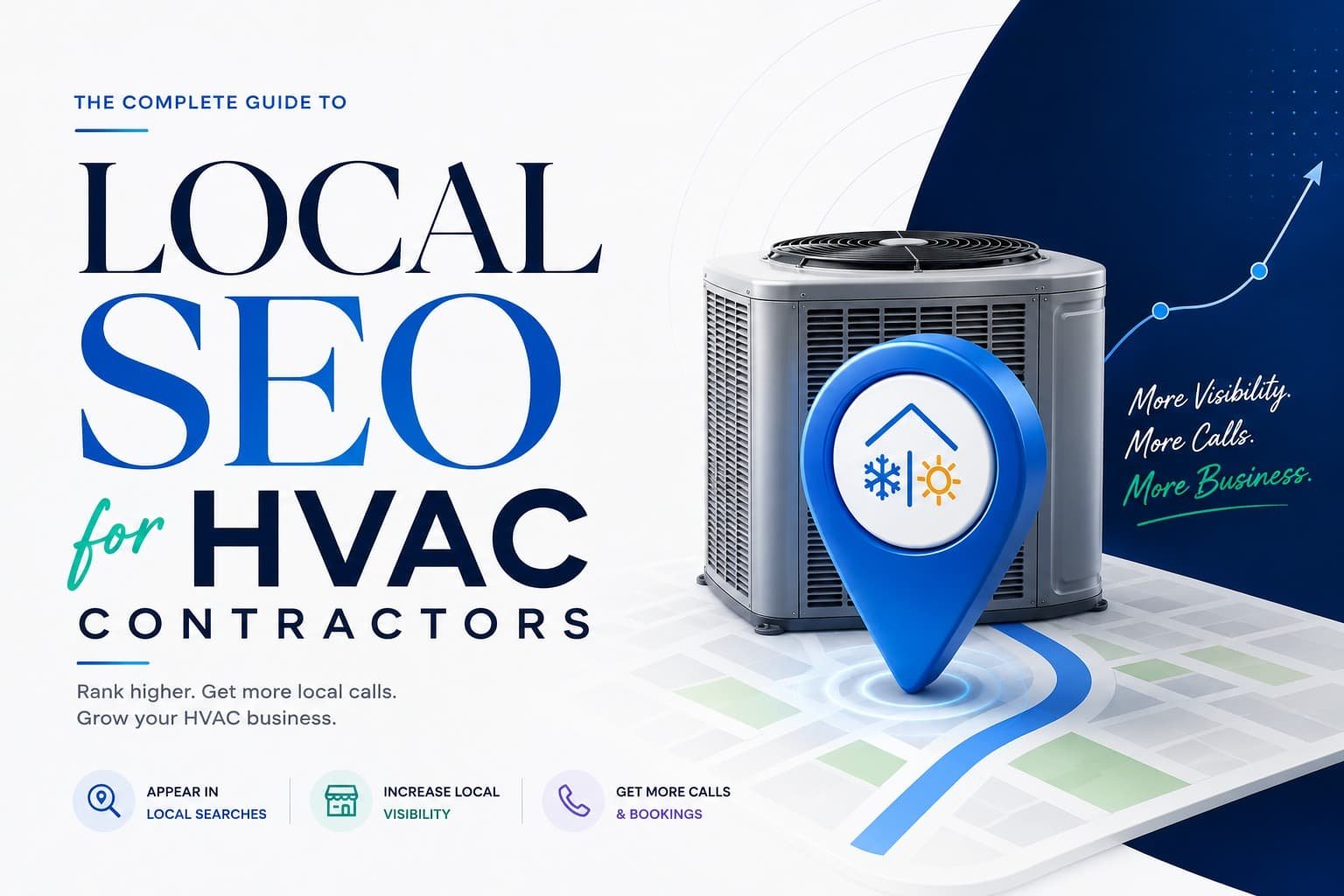
This guide is for HVAC contractors and owners who want more of the calls that come from “AC repair near me” searches, the ones that turn into booked jobs, without wading through generic SEO theory.
Local SEO for an HVAC contractor comes down to three things: your Google Business Profile, since it carries the most controllable ranking weight; a steady review system, since Google and homeowners both weigh it heavily; and a website built around dedicated service and service-area pages instead of one catch-all Services tab. Get those right, in that order, and you’ll show up for the moment that actually matters, the one when someone’s furnace just died and they’re calling whoever’s on the map.
Here’s the uncomfortable truth about HVAC leads: when someone’s furnace dies at 2 a.m. in January, they’re not browsing. They grab their phone, type “furnace repair near me,” and call one of the first three names they see on the map. If your business isn’t in that little map box, what SEOs call the Local Pack, you don’t exist to that customer. It doesn’t matter how good your techs are or how fair your pricing is.
That’s what local SEO is really about. Not vanity rankings, not traffic for its own sake, just showing up at the exact moment a nearby homeowner needs you, and being the obvious choice when you do.
The good news is that most of your competitors are doing this badly, or not at all. A large share of small businesses still haven’t fully claimed or optimized their Google Business Profile. The field is more open than it looks. This guide walks you through exactly how to claim that space, in the order that actually moves the needle.
How Local Search Actually Decides Who Ranks
Google boils local rankings down to three things, and once you understand them, everything else clicks into place.
Relevance is how well your business matches what someone searched for. If a homeowner types “heat pump installation,” Google wants to show businesses that clearly do heat pump installation, not a general handyman who mentions HVAC once.
Proximity is how close you are to the person searching, and it’s a heavy factor, especially for home-service businesses where people expect someone nearby. Here’s the part that frustrates a lot of contractors: you can’t control it. Someone three towns over will usually see the shop nearest them, not you. So the smart move is to stop fighting physics and focus on the factors you can influence.
Prominence is basically how well-known and trusted your business appears, driven heavily by reviews, links, and how complete and active your online presence is.
Local ranking studies generally agree on the order even when the exact weights vary: Google Business Profile signals lead, review signals and on-page website signals follow close behind, and links contribute a smaller but real share, with behavioral signals, citations, and personalization filling out the rest. Keep that order in your back pocket, because it tells you exactly where to spend your time. Let’s go through it.
Google Business Profile: Your Biggest Lever
If you only fix one thing this month, fix your Google Business Profile. It’s the free listing that feeds the map results, and it carries more controllable ranking weight than anything else. The payoff is real too: a fully completed profile consistently earns meaningfully more clicks than a half-finished one.
A few things matter most here. Get your primary category right first, since this is one of the highest-leverage single settings in all of local SEO, and it’s the fastest to take effect, sometimes shifting rankings within days. Pick the category that most precisely describes your core business, HVAC Contractor, Air Conditioning Repair Service, Furnace Repair Service, then add relevant secondary categories to widen the searches you can appear for. Don’t just pick one and move on.
Fill out every single field: hours, services, service areas, attributes, and a business phone that matches your website, all of it. Google rewards completeness because a complete profile helps it understand exactly what you do and where. Empty fields are missed opportunities.
List 24/7 hours if you do emergency work. This one’s a quiet edge. If you offer after-hours or emergency service, set your hours to reflect it. Google tends to deprioritize businesses that show as closed when someone searches, and after-hours searches are far less competitive, so you can scoop up “emergency furnace repair” calls at 11 p.m. that your 9-to-5 competitors never see.
Add real photos, and keep adding them: your trucks, your techs in uniform, actual job sites, before-and-afters. Freshness matters more than most people think. Profiles that add photos every couple of weeks tend to noticeably outperform ones that update quarterly. Set a recurring reminder and have your crew snap a few clean shots on jobs.
One thing not to sweat: the business description. Google has confirmed it doesn’t use the description text in ranking, so write it for the human reading it, not to cram in keywords.
Reviews: The Trust Signal Google and Customers Both Read
Reviews do double duty. They’re one of your strongest controllable ranking factors, and they’re also the thing that decides whether someone clicks you over the shop next door. The large majority of consumers read online reviews before choosing a local business, and a rating under 4.0, or a review count in the single digits, measurably hurts your conversion rate.
Here’s what most contractors get wrong, though: they think reviews are about the total number. They’re not, at least not entirely. Google cares a lot about three things. Velocity: a steady trickle of new reviews beats a big pile from two years ago. Ten reviews spread across ten months signals an active, healthy business; fifty reviews all dated the same week signals something fishy. Response rate: businesses that reply to most of their reviews tend to see a ranking benefit, so reply to the good ones, and reply calmly and professionally to the bad ones. Recency: a review from last week counts for more than one from 2023.
Build a system, not a one-time push. The simplest version that works: text the customer a direct link to your Google review page the same afternoon you finish the job, while they’re still happy the house is cool again. Same-day, direct link, friendly ask. That one habit will outperform any clever trick.
Your Website’s Real Job in Local SEO
A lot of contractors assume the profile does everything and the website is just a formality. It’s not, on-page signals still carry a real share of local ranking weight, and your site does two jobs the profile can’t.
Dedicated service pages are the first. One page per major service, AC repair, AC installation, furnace repair, heat pumps, indoor air quality, maintenance, not one giant Services page listing everything. When someone searches “furnace repair,” Google wants to send them to a page about furnace repair, and a focused page ranks far better than a paragraph buried in a catch-all.
Service-area pages are the second, and they’re the big one for HVAC. A separate page for each town or suburb you cover, with local reviews, the neighborhoods you serve, and real job photos from that area. Fair warning: these pages won’t get you into the map pack for a town unless your profile is physically based there, but they’re genuinely powerful for the regular organic results below the map, and that’s a lot of “[service] in [town]” traffic your competitors are ignoring.
Two more technical must-haves round it out: LocalBusiness schema markup, structured code that spells out your name, address, phone, hours, and service area for search engines and increasingly for AI results, and a fast, mobile-first site. Remember who your visitor is: someone standing in a hot house holding their phone. If your site crawls or they have to pinch and zoom to find your number, you’ve lost them.
NAP Consistency and Citations
NAP stands for Name, Address, Phone number, and the rule is simple: it needs to be identical everywhere it appears, your website, your profile, Yelp, Angi, the Better Business Bureau, every local directory. “Suite 200” in one place and “Ste. 200” in another, or an old phone number lingering on some directory, sends Google mixed signals about whether you’re a real, trustworthy business.
Some honesty here: citation building used to be the foundation of local SEO, and it’s faded in importance. You still want consistent NAP across the core directories, but grinding out hundreds of citations gives you far less return than it did five years ago. Get your NAP clean and consistent on the major platforms, then move on. Don’t let anyone sell you a thousand-citation package as your main strategy.
Local Content That Actually Ranks
You don’t need to blog every day. You need content that answers what local homeowners actually search and reinforces where you work.
Think seasonal and specific: “why is my AC freezing up in [your city]’s humidity?” or “how to tell if your furnace can survive another [region] winter.” Content tied to real local conditions and real questions does two things: it pulls in organic traffic, and it strengthens the relevance connection between your website and your profile.
The keyword is useful. Write the thing a homeowner would actually find helpful, in plain language, and let the location and service keywords fall in naturally. Google’s gotten good enough at understanding intent that keyword-stuffing now hurts more than it helps.
Local Links Worth Chasing
Links from other websites still signal authority, and for local SEO, local links punch above their weight. You don’t need a link-building agency, you need to think about who in your community already has a website.
The realistic wins: your supplier and manufacturer partner pages, the local chamber of commerce, sponsoring a youth sports team or a community event, and genuine local press if you do something newsworthy. A link from your town’s little league page or a local news write-up is worth more for local relevance than a dozen random directory links. Quality and local-ness beat volume every time.
Showing Up in AI Search
This is the fastest-moving shift in local search, and most contractors haven’t caught up yet. People are increasingly asking AI assistants for recommendations instead of scrolling Google, and that share is growing quickly. Google’s own AI Overviews now appear on a meaningful chunk of local searches too.
The reassuring part: you don’t need a whole separate strategy. AI systems favor businesses that look real, active, and consistent, the same things good local SEO already builds. What tips the scales toward AI visibility is consistency of your business information everywhere it appears, the same name, the same service terms, the same description of what you do, referenced across your website, your profile, and directories. Clean structured data, that schema markup again, and a complete, consistent presence are what get you pulled into AI answers. Do the fundamentals well and you’re most of the way there.
Myths to Ignore (So You Stop Wasting Time)
A few tactics refuse to die despite being tested and found wanting. Skip these.
Geotagging your photos. The theory was that embedding GPS data in your images helps you rank locally. In practice, Google strips that metadata the moment you upload, and testing has found no meaningful ranking benefit from it.
Posting daily to Google Posts for rankings. Independent testing has found that GBP posts don’t produce direct ranking movement. They can help click-through and engagement, which has some value, so post if you like, just don’t expect them to lift your position.
Keyword-stuffing your GBP description. As mentioned, Google doesn’t use it for ranking. Cramming it with keywords just makes it read badly to the customer.
Every hour you don’t spend on these is an hour you can put into your profile, your reviews, or your service-area pages, the stuff that actually works.
Where to Start (The Priority Order)
If all of this feels like a lot, here’s the honest sequence. Do it in this order and you’ll get the most return for the least effort.
- Fix your GBP primary category and make sure it’s exactly right. Fastest impact, biggest lever.
- Complete every field on your profile, and set 24/7 hours if you offer emergency service.
- Build a review system, a same-day text with a direct review link after every job, and start responding to every review.
- Create dedicated service and service-area pages on your website with matching NAP and local schema.
- Clean up your NAP across the core directories so it’s identical everywhere.
- Earn a handful of genuinely local links over time.
Notice what’s first: nothing that costs money, just things you control. That’s the whole point of local SEO for a contractor. The highest-return work is usually free, it just takes consistency.