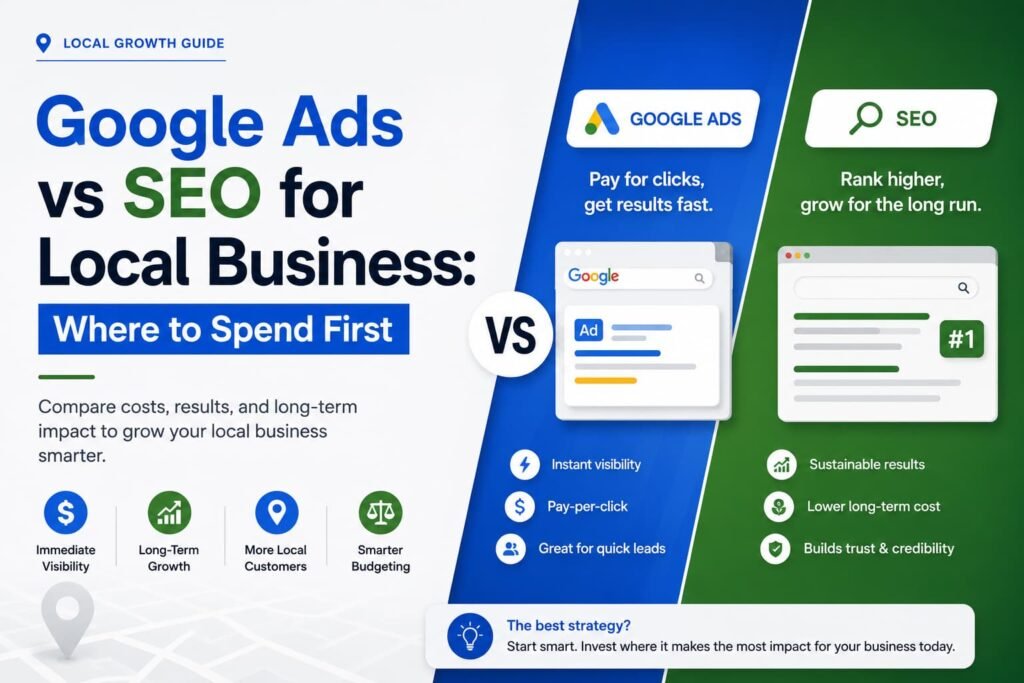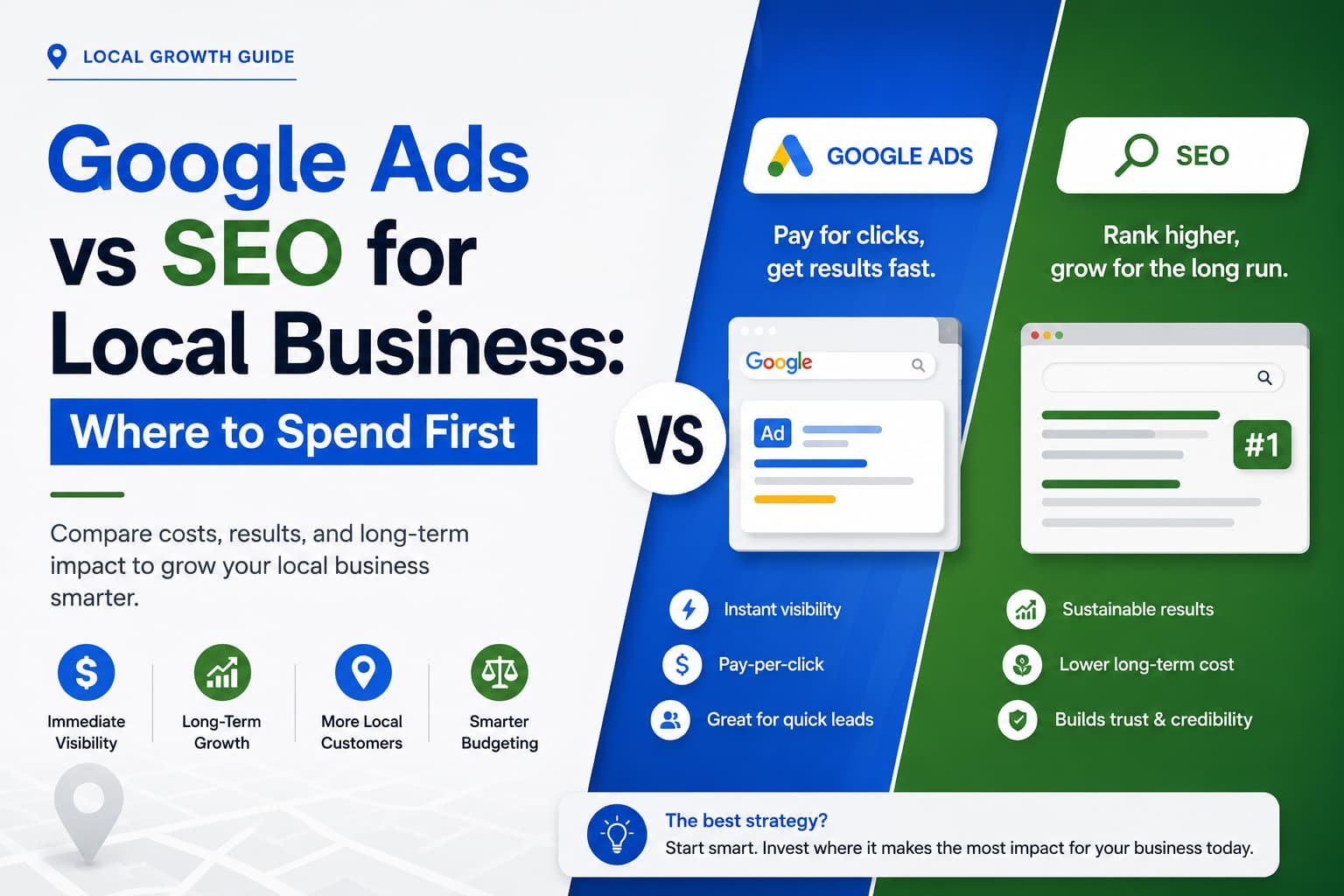
If you have to pick one first, start with Google Ads if you need leads within the next two weeks and can afford to pay for each one while you build something more durable, and start with SEO if you can wait two to four months for results but want a channel that keeps working without a monthly bill attached to every phone call. Most local businesses eventually need both, but almost nobody has the budget to run both hard at once, so the real question isn’t which one is better. It’s which one solves the problem you actually have right now.
The Fundamental Difference
Google Ads is rented visibility. You show up at the top of the results the moment your campaign goes live, and you keep showing up for exactly as long as you keep paying. Stop the campaign and you disappear instantly, as if you were never there.
SEO is owned visibility, or as close to owned as anything on the internet gets. It takes real time and consistent work to rank, but once you’re there, you keep showing up without paying per click. The traffic isn’t free, you paid for it with time and effort instead of cash, but it doesn’t evaporate the moment your budget runs dry.
Neither of those facts makes one option better than the other. They make each option better suited to a different situation.
What Google Ads Actually Gets You
Speed is the whole point. A campaign can be live within a day, and you can be getting calls by the end of the week. For a business with an urgent gap, a slow season, a new location that needs customers now, a competitor who just opened down the street, that speed is worth paying for.
You also get control that SEO doesn’t offer. You can turn spend up or down instantly, target the exact radius you serve, and test different offers or messages in days instead of months. If a headline isn’t converting, you know within a week and can change it. SEO doesn’t give you that kind of immediate feedback loop.
The tradeoff is that every lead has a direct, ongoing cost attached to it. Cost per click varies enormously by industry and how competitive your local market is, some trades pay a few dollars a click, others pay considerably more for high-intent keywords, and that cost doesn’t decrease over time the way SEO’s cost per lead generally does. You’re also competing in a live auction against every other local business bidding on the same keywords, which means your costs can rise simply because a competitor decided to spend more this month.
What SEO Actually Gets You
Compounding value is the core advantage. A service page that ranks well for “emergency AC repair in [city]” keeps generating calls month after month without an ongoing per-click cost. The work you did to build it doesn’t disappear when your budget tightens, which makes SEO fundamentally different from a channel you have to keep feeding to keep working.
It also builds trust differently than an ad does. A lot of people, consciously or not, treat organic results as more credible than paid ones, since they read them as “this business earned its way here” rather than “this business paid to be here.” For businesses where trust matters enormously before someone will let a stranger into their home or their mouth, that distinction carries real weight.
The tradeoff is time and patience. Meaningful ranking improvements typically take a few months to show up, sometimes longer in competitive markets, and there’s no dial you can turn to speed that up. You also can’t fully control which keywords you show up for the way you can with ads; you’re working with what Google decides is relevant, not what you decide to bid on.
The Decision Framework
A few questions cut through most of the back-and-forth.
How urgent is the need? If you need leads this month, not this quarter, ads are the only channel that can actually deliver that. SEO is not a rescue plan for a business that’s short on customers right now.
What’s your budget, realistically? If you can only spend a modest amount consistently, that budget often does more for you spread across months of SEO work than it does bidding against well-funded competitors in a Google Ads auction, where you might get outbid into irrelevance by a bigger company with a bigger budget.
How competitive is your local market? In a market with a handful of established competitors already dominating both the map pack and the ads, breaking in with SEO takes real time, and paid ads might be the faster way to get visible while your organic presence builds in the background.
Do you already have decent organic visibility? If your Google Business Profile is a mess, your reviews are thin, and your site barely has service pages, dumping money into ads sends traffic to a leaky, unconvincing site. Fixing the fundamentals first usually pays off before you pay to send traffic at scale.
Can you sustain either channel long enough to see results? A two-month SEO effort that gets abandoned right before it would have paid off is money and time wasted. A one-week ad test tells you almost nothing. Both channels punish businesses that start and stop.
Why Most Local Businesses End Up Doing Both
In practice, the businesses that grow the most steadily use ads and SEO together, just not necessarily starting at the same time or with the same intensity. A common, sensible sequence looks like this: run ads to generate leads now while investing in the SEO fundamentals that take months to mature, then gradually shift budget away from ads as organic traffic starts pulling its weight, using the ad spend you free up to go after new markets or seasons instead of dropping it entirely.
The two channels also feed useful information to each other. Ads show you, in real time, which headlines, offers, and service pages actually convert visitors into leads, since you get that feedback in days instead of months. That data is worth feeding straight back into your organic service pages so the traffic SEO eventually sends converts at a similar rate.
Common Mistakes
A few patterns show up again and again. Businesses expect SEO to work like ads, judging it as a failure after a few weeks when it was never going to move that fast. Businesses run ads and send that traffic to a weak, unconvincing website, effectively paying to expose a conversion problem rather than fixing it first. Businesses drop SEO entirely the moment ads start working, forgetting that the ad spend never stops being a cost while SEO’s cost curve trends the opposite direction over time. And businesses split a small budget evenly across both channels instead of committing enough to either one to actually see results, which often means neither channel gets enough investment to work.