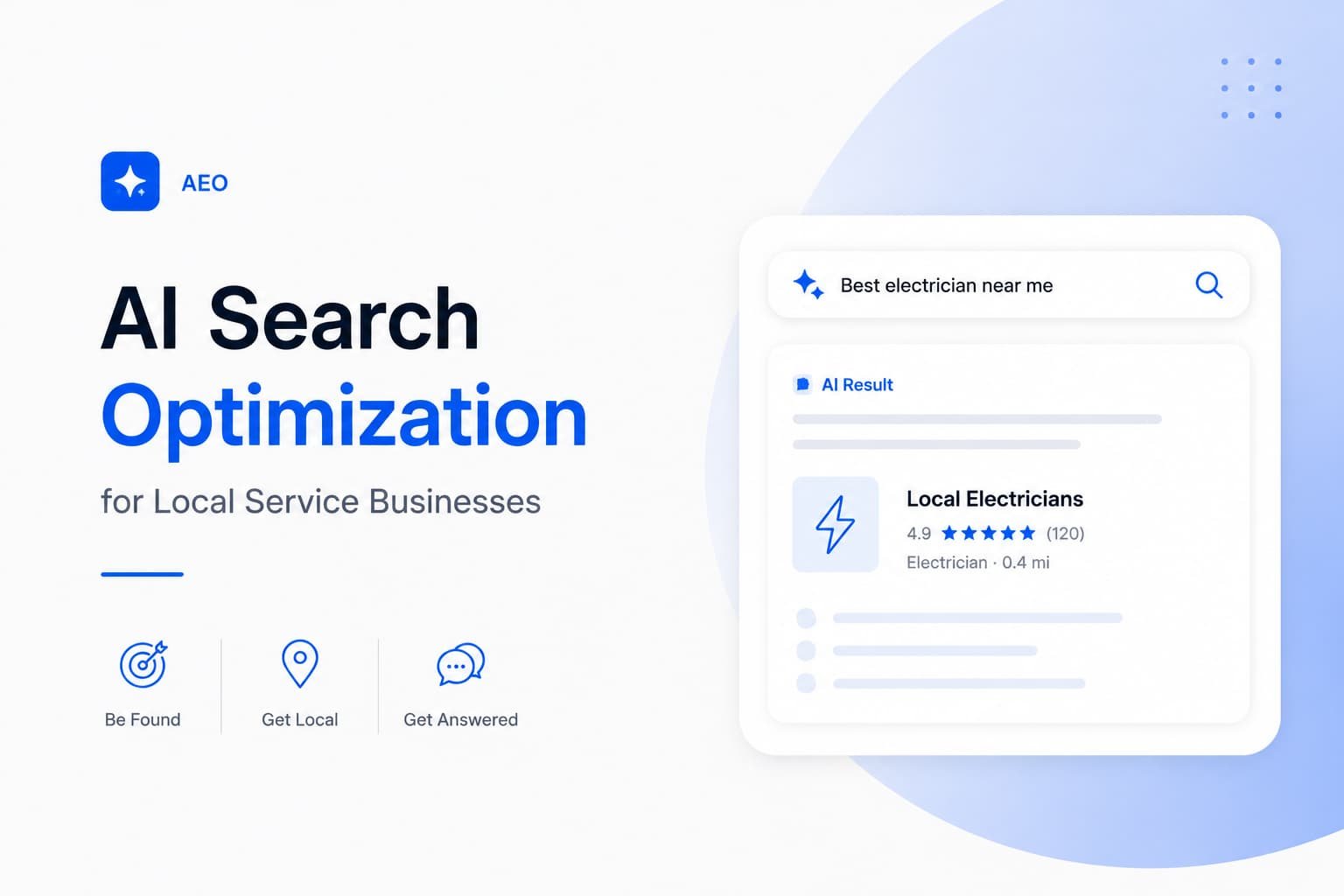
AEO for a local service business means becoming the answer AI tools give when someone nearby asks “who’s the best [your service] near me” or “how much does [your service] cost in [your city].” That comes down to a complete, active Google Business Profile, consistent business details everywhere you appear online, website content that leads with direct answers instead of buildup, and a presence in the places AI already trusts, from your own reviews to the local communities where people ask for recommendations.
Something quietly changed about how people find local businesses. A homeowner with a broken furnace used to type “HVAC repair near me” and scroll through Google results. Now a growing share of them just ask ChatGPT, open Perplexity, or glance at the AI Overview that appears before the first organic result on Google itself.
The AI tool gives one synthesized answer, maybe names two or three businesses, and that’s often where the search ends. No scrolling, no comparing tabs, no second-guessing. Just a recommendation and a phone number.
A growing share of commercial searches that used to generate organic clicks are now being intercepted by AI search instead. The businesses named in those AI answers get the call. The ones not named don’t exist to that searcher.
That’s what Answer Engine Optimization, or AEO, addresses. It’s not a replacement for traditional SEO. It’s the layer on top of it that determines whether you get cited when AI synthesizes an answer, rather than just when a human clicks a blue link. Most businesses haven’t started working on this yet, even though many expect it to significantly affect their visibility within the next few years. The window for getting ahead of it is genuinely open.
This guide covers what drives AI citations for local service businesses and what to do about it, in the order that matters.
What AEO Actually Means for a Local Business
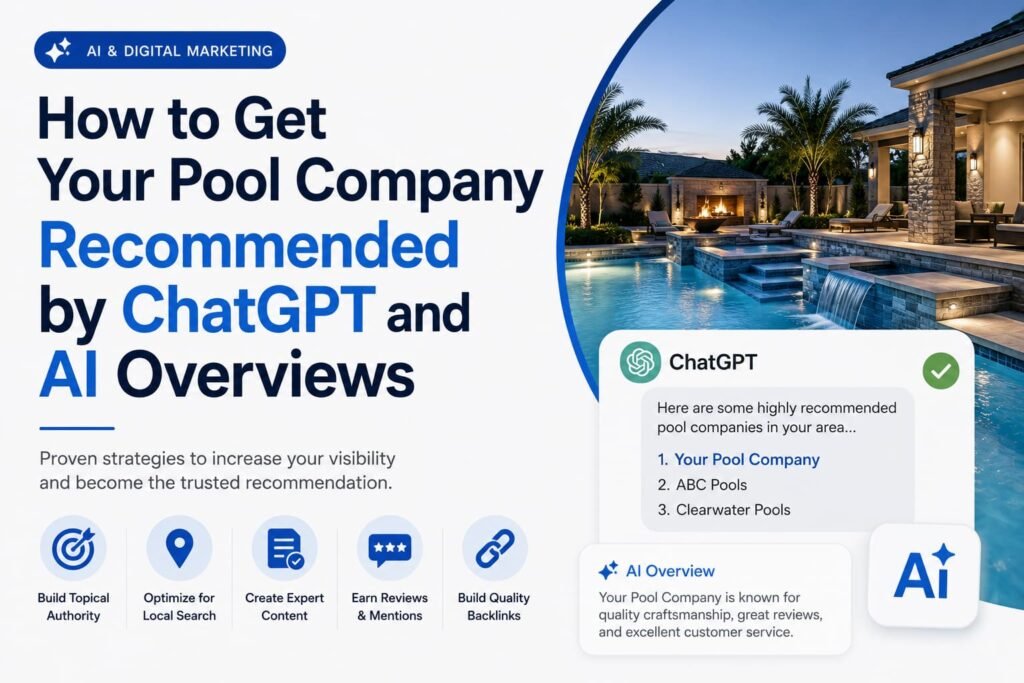
AEO for a local business means being the name an AI recommends for a nearby need, not becoming a global authority on your industry. For a dentist, pool builder, HVAC contractor, or landscaper, that’s a simpler bar than the enterprise-level discourse around AEO suggests. You’re trying to be the business an AI recommends when someone nearby asks “who’s the best [your service] near me” or “how much does [your service] cost in [your city].”
The mechanics of that are straightforward. AI tools build their local recommendations from a handful of consistent sources: your Google Business Profile and Maps data, your reviews across platforms, how consistently your business details appear across the web, and how well your website content answers the specific questions people are asking. Cross-reference all of those and you’ll find the levers are largely the same ones good local SEO already pulls.
The difference is in the framing and the content structure. AI engines don’t rank pages. They cite passages, pulling short, self-contained answers that can be extracted and used in a generated response. A page that ranks first on Google but doesn’t contain a clean, extractable answer often gets skipped in favor of one that ranks fifth but answers the question directly.
The Foundation: Why Traditional Local SEO Still Matters
Good traditional local SEO is the prerequisite for AEO, not the alternative to it. A large share of AI Overview citations come from pages that already rank well in ordinary organic search results, which means an optimized Google Business Profile, consistent business details everywhere, strong reviews, a fast mobile site, and dedicated service and city pages are still the foundation. AEO builds on top of that.
If your local SEO fundamentals are solid, you’re already partway there. The tactics below are what take you the rest of the way.
1. Your Google Business Profile Is AI’s First Source
When someone asks ChatGPT or Google’s AI for a local service recommendation, GBP and Maps data are among the primary sources those tools pull from. A complete, accurate, active profile is not just a local SEO asset anymore. It’s your AI visibility foundation.
The specifics that matter most: the right primary category (this signals what kind of business you are to the AI, not just to Google), a complete services list with descriptions, current hours, fresh photos, and a steady stream of recent reviews. A profile that looks abandoned looks the same to an AI recommender as it does to a human.
2. Consistency Across Every Platform Is Non-Negotiable
AI tools cross-reference your business across multiple sources before recommending you. If your name, address, or phone number differs between your website, Google, Yelp, Facebook, and industry directories, the AI loses confidence and tends to leave you out of the answer or describe you inaccurately.
The fix is an audit of every place your business appears online and a single canonical format applied consistently everywhere. Same name, same address, same phone, same service description. For local businesses especially, this is foundational.
3. Structure Your Content So AI Can Extract It
This is where AEO diverges most clearly from traditional SEO, because Google ranks pages while AI engines cite passages, and that distinction changes how you should write.
A page that opens with three paragraphs of company history before getting to the question a searcher asked is hard for AI to cite, because there’s no clean, self-contained answer it can lift. A page that leads with a direct, plain-language answer to the question and then expands on it is easy to cite, because the extractable passage is right at the top.
For local service businesses, this applies most powerfully to three formats. FAQ sections on every service and city page, written as real questions people actually ask (“How long does a pool installation take?”, “Do you offer same-day furnace repair?”, “What does a full dog groom include?”) with direct answers in the first sentence or two, are exactly the format AI pulls from. Cost and process pages answering questions like “how much does an inground pool cost” or “how long does dental implant surgery take” are among the highest-cited categories in local service AI answers, especially with local context and a current date. And definitive statements outperform hedged prose: cited pages tend to use far more definitive language than skipped ones. “A standard gunite pool in the [region] typically takes 10 to 14 weeks from design sign-off to first swim” is extractable. “Build times can vary significantly depending on many factors” is not.
4. Keep Your Content Fresh
This one surprises people, but recency matters a lot for AI citations. The large majority of AI citations for commercial queries come from pages updated recently, within the past year and often within the past six months, and pages that sit stale for long stretches are noticeably more likely to lose their citations over time.
For a local service business this is actually good news, because the update doesn’t have to be a full rewrite. Updating a stat, refreshing a pricing range, adding a current example, or revising an FAQ based on what customers are actually asking now is enough to signal freshness. Build a quarterly review habit for your most important pages.
5. Get Mentioned in the Places AI Trusts
Your own website is not AI’s only source, and sometimes not even its primary one. Independent research has found that community platforms like Reddit make up a surprisingly large share of AI citations across multiple AI tools, with some platforms pulling from community discussion even more heavily than others.
For a local service business, this doesn’t mean you need a Reddit presence. It means you need to be mentioned authentically in the places people discuss your category: community Facebook groups, local neighborhood platforms like Nextdoor, home improvement forums, and local news outlets or community directories. When a real community member recommends “the pool builders I used” or a local blog features “best HVAC companies in [city],” those mentions become part of what AI cites.
You can’t manufacture this, but you can encourage it. Ask happy clients to share their experience on community platforms. Sponsor local events that generate local press. Participate in the community conversations where your services come up naturally.
Third-party review platforms matter here too. Houzz for pool builders and landscapers, Healthgrades and Zocdoc for dentists, Angi for contractors, and your category’s equivalent. AI tools cross-check reviews across platforms, so presence on the ones your industry uses carries real weight.
6. Technical Basics That Unlock AI Visibility
A few technical settings directly affect whether AI tools can find and cite you.
Your robots.txt file needs to allow the major AI crawlers. GPTBot is ChatGPT’s crawler. OAI-SearchBot handles ChatGPT search features. PerplexityBot is Perplexity’s. Google-Extended covers AI Overviews and Gemini. Anthropic’s crawler covers Claude. If any of these are blocked, those platforms literally cannot cite you, regardless of how good your content is.
Schema markup, LocalBusiness or the more specific subtype for your industry (Dentist, HVACBusiness, LandscapingBusiness) spelled out in JSON-LD, gives AI tools a clean, machine-readable summary of your business: name, address, service area, services offered, and hours. FAQ schema on your Q&A sections directly tells AI what questions you answer. These don’t guarantee citations, but they make your content substantially easier to extract and use.
An llms.txt file, a simple plain-text file at the root of your domain, gives AI systems a clear summary of what your business does, where you operate, and what services you provide. It’s optional but increasingly recommended as a straightforward signal that your site is AI-friendly.
Page speed and mobile performance matter too. AI crawlers, like all crawlers, move on quickly from slow pages, and a site that loads in under three seconds on mobile is less likely to be partially or incompletely indexed.
7. How to Test Whether It’s Working
Unlike traditional SEO where Google Search Console shows you rankings, AI visibility requires a different feedback loop.
The simplest version: open ChatGPT, Perplexity, and Google in separate tabs and run the queries you’d want to appear for. “Best [your service] in [your city].” “How much does [your service] cost in [your area].” “Who offers [specific service you specialize in] near [your city].” Screenshot the answers. Note who gets cited and whether you appear. Run the same queries every two to three weeks.
If a competitor consistently gets cited and you don’t, look at what their content does differently. Frequently it comes down to a more direct answer format, more recent content, stronger reviews across more platforms, or a cleaner entity presence across the web.
Perplexity is the fastest platform to test on because citations are visible inline and it retrieves content in near real-time. Changes to your content can show up there within days, versus weeks for Google AI Overviews. Use it as your primary feedback loop.
The Local Advantage Nobody Talks About
Local businesses have a structural advantage in AI search that larger, national competitors don’t. Geographic relevance is a signal AI engines use to match results to location-based queries. A plumber in Denver with a strong, consistent, locally grounded presence (GBP, reviews, city pages, community mentions) has a meaningful advantage over a national home-services directory when someone in Denver asks an AI who to call. The directory might have more authority in traditional search. The local business has more geographic specificity, and for location-based queries that specificity matters.
You don’t have to out-rank the big national directories across all of Google. You just have to be the most clearly, credibly local business in your category when the AI tries to answer “who does this in [your city].”
Where to Start
Most of this is work that reinforces good local SEO and makes it AI-visible. Do it in this order.
- Check your robots.txt and allow the major AI crawlers. Takes ten minutes and removes a binary blocker.
- Audit your business details across every platform and make them identical everywhere.
- Add or update schema markup: LocalBusiness, service schema, FAQ schema on your key pages.
- Rewrite your most important service pages so they lead with a direct answer to the question the page is trying to rank for.
- Add or improve FAQ sections on every service and city page with the questions people actually ask.
- Publish honest cost and process content for each service with a current date.
- Build a quarterly content refresh habit for your highest-priority pages.
- Run a manual citation audit every two to three weeks and track whether you appear.
None of this requires new tools or a significant budget. It mostly requires rethinking how your existing content is written and making sure your business information is clean and accessible everywhere AI looks.