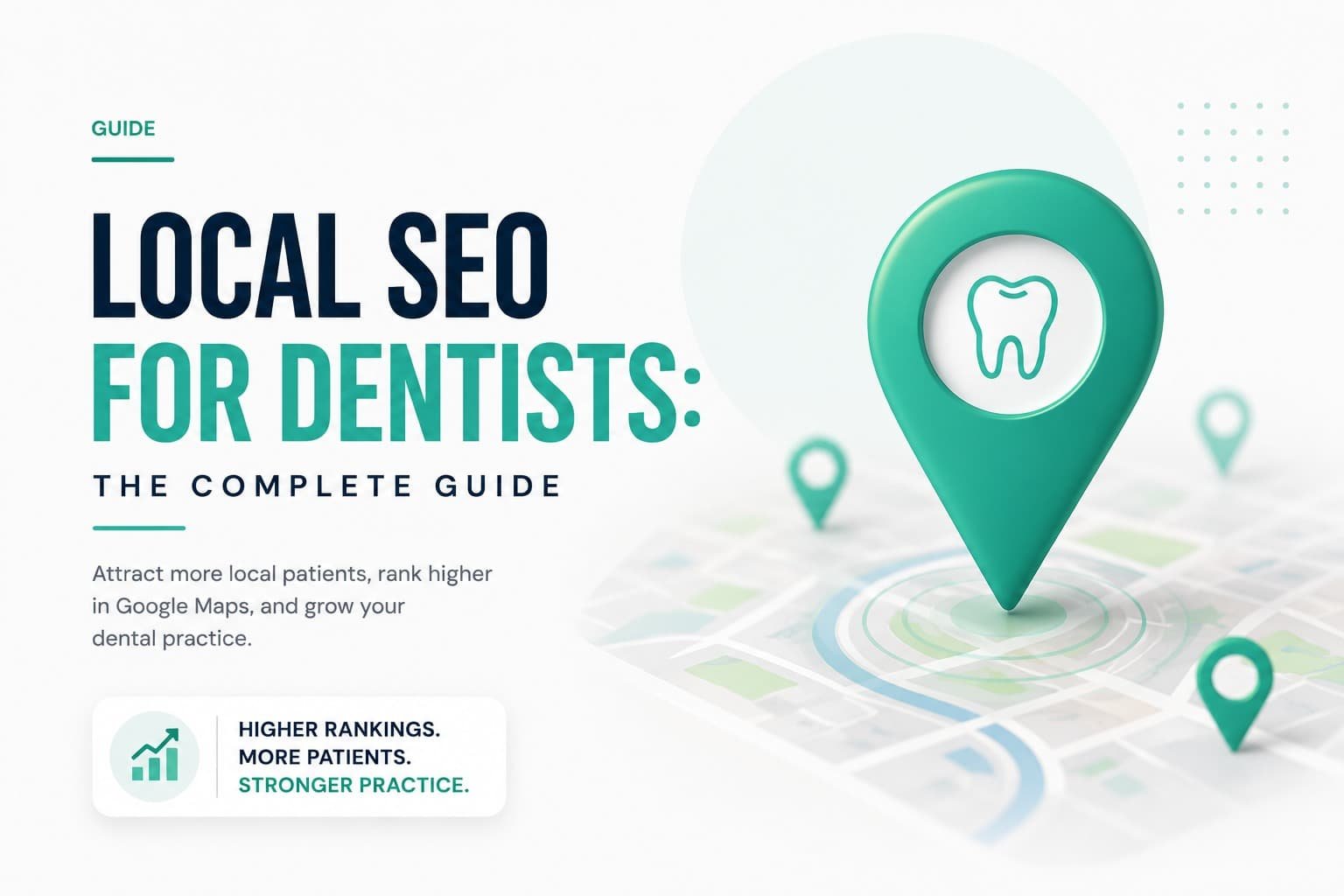
Local SEO for a dental practice comes down to three things: showing up in Google’s Map Pack, giving patients a reason to trust what they see once they’re there, and turning that visibility into booked appointments. Most of that work lives inside your Google Business Profile, though your website, your review pattern, and how consistent your business details are across the web all play a real part too.
Here’s why it matters more than it used to. A patient looking for a dentist today pulls out their phone, types “dentist near me,” and Google hands back three practices on a map, each with a star rating and a review count. They skim a couple of reviews, glance at the hours, and tap Call, often before visiting a single website. For a growing share of patients, your Google listing isn’t a stepping stone to your site. It’s the first impression, and sometimes the only one.
The demand side of this is healthy. Most people searching for a dentist today start with a search engine rather than asking around, and plenty of practices still have room in their schedule they’d like filled. The patients exist. The constraint is being found and chosen in that local moment, and most practices handle it poorly, which leaves a real opening for the ones who don’t.
Key Takeaways
- The Map Pack is often your entire first impression. Patients frequently decide straight from your Google listing without ever visiting your site.
- Your Google Business Profile is the single biggest lever, and your category configuration determines which searches you’re even eligible to appear for.
- Dentists are a physical destination, not a service-area business, so an accurate address and hours matter far more than they would for a mobile contractor.
- Reviews are the patient’s first filter. A low star rating or a thin, stale review count knocks a practice out of consideration fast, so both volume and how you respond to them matter.
- Patients search by insurance and by specialty (“cosmetic dentist near me,” “dentist that takes [plan]”), so your profile and site need to answer those questions specifically.
How Patients Actually Find a Dentist Now
Google decides who shows up in local results based on three factors, and each one points to work you can actually do.
Relevance is how well your practice matches the search, driven mostly by your categories and services. A practice set up only as “Dentist” simply isn’t eligible for a lot of specific, high-value searches like “cosmetic dentist” or “emergency dental.”
Distance is how close you are to the searcher. Because dentists are a destination patients travel to, your physical location and a correct address genuinely matter here, which is different from a plumber or a pool builder who drives out to the customer instead.
Prominence is how established and trusted you appear, built largely from your reviews, your profile completeness, and how actively you keep it updated. This is the competitive layer that separates two practices sitting a few blocks apart.
Nearly everything below strengthens relevance and prominence, the two you actually control. Start with the profile, since it carries the most weight.
Your Google Business Profile Is the Whole Game
If you fix one thing this quarter, fix your Google Business Profile. It’s the free listing that feeds the Map Pack, it’s where patients look first, and a complete, active one consistently fills appointment books that a neglected listing can’t. Most dental profiles are placeholders: an address, a phone number, and little else. The practices winning on Google treat the profile as a patient-acquisition system, not a directory entry they set up once and forgot about.
Get your categories right, including specialty categories
Your primary category is the highest-impact setting on the whole profile, because it decides which searches you can appear for at all. For a general practice, “Dentist” is the right primary category, since it’s what makes you eligible for “dentist near me.” But here’s the move most practices miss: if a specialty is a core part of your business, consider making that the primary instead.
A cosmetic-focused practice using “Dentist” rather than “Cosmetic Dentist” as its primary is competing in a broader, less targeted pool and missing higher-intent searches. The same logic applies to orthodontics (“Orthodontist”), children’s care (“Pediatric Dentist”), or an implant or emergency focus. Pick the primary that matches where your highest-value patients actually come from, then add secondary categories, up to nine total, for everything else you genuinely offer. Common useful ones include Cosmetic Dentist, Teeth Whitening Service, Emergency Dental Service, Dental Implants Provider, and Pediatric Dentist. Only add categories you actually offer, and avoid rapid-fire changes, since category churn is a common trigger for profile suspensions.
Remember you’re a destination, not a service area
This is where dental differs from a lot of local SEO advice written for contractors. A plumber hides their address and lists a service area. You do the opposite: patients come to you, so your real address should be on display, and it feeds directly into the distance factor. That makes two things critical: an address that exactly matches your website and every other listing, and hours that are always accurate, including holidays. Nothing damages a profile’s trust faster than a patient showing up to a closed sign when Google told them you were open.
Fill out every field, since patients and AI tools both read it
Every field on the profile is a signal, and a half-filled one quietly costs you. Services should list every treatment with a short description, since Google uses this to match you to specific patient searches. Products lets you feature key services like Invisalign, implants, or cosmetic dentistry with an image and a link straight to the matching page on your site. Insurance accepted matters because patients genuinely search “dentist that takes [insurance] near me.” Attributes covers accessibility, languages spoken, amenities, and identity attributes that help the right patients self-select. An appointment link turns a ready patient into a booking without a phone call, one of the fastest conversion wins on the whole profile. And the description, 750 characters, isn’t a ranking factor, so write it in plain language for the patient reading it (and for the AI tools that now read it too).
Add real photos and post weekly
Upload genuine photos of your exterior, reception, operatories, and team, never stock, and keep adding new ones. Fresh, authentic photos get more engagement and signal an active practice. Use Google Posts as well. They expire after seven days, so posting weekly is worth the few minutes it takes, and practices that post consistently tend to see more clicks from their listing over time.
Reviews: The Patient’s First Filter
In healthcare, reviews carry even more weight than usual, because a patient is choosing who to trust with their body. Most consumers read reviews before choosing a local business, a large share won’t consider one rated below 4 stars, and a thin, sparse review count reads as a red flag even when the ratings themselves are good. Rather than chasing a specific number, aim for a review count and average that’s clearly ahead of the other practices showing up in your Map Pack.
Google weighs three patterns closely. Velocity, a steady stream of fresh reviews, beats a big pile of old ones and signals an active, currently-chosen practice. Response rate matters because future patients read how you handle criticism more closely than the criticism itself, so reply to every review, positive and negative. And recency counts too: a review from last week outweighs one from two years ago.
The system that works is simple. Build a review request into your post-appointment routine, ideally a short text or email sent within about an hour of the visit, while the patient still feels good about it, with a direct link to your Google review page. Something like:
“Hi [Patient Name], it was great seeing you today! If you’re happy with your visit, would you mind leaving us a quick Google review? It genuinely helps other local families find us. Here’s the link: [direct link]. Thank you!”
Two cautions. Don’t ask for reviews in large batches, since a sudden spike can look suspicious to Google’s systems, a steady drip is safer. And while Google is the platform that matters most by far, patients researching a dentist often cross-check Healthgrades, Zocdoc, and Yelp too, so it’s worth keeping those accurate as well.
Your Website’s Role in Local Rankings
Your profile gets you found. Your website does the jobs the listing can’t, and on-page signals still influence local rankings. A few pages matter most for dental specifically.
A dedicated page per treatment beats a shared paragraph every time. Give general care, cosmetic, Invisalign, implants, emergency, pediatric, and sedation each their own page. “Dental implants in [city]” ranks far better with a substantive implant page behind it, and each page is also a chance to reassure an anxious patient by explaining the procedure plainly.
Location pages matter if you serve multiple areas or run multiple offices. A real “Dentist in [city]” page with genuinely local content beats a generic one, and each physical office should have its own page tied to its own Google Business Profile.
Content that answers real patient questions pulls in high-intent traffic early, especially cost and comparison searches like “how much does Invisalign cost in [city]” or “veneers vs. bonding.” These let you build trust and answer the insurance question before the first call ever happens.
Round it out with Dentist or LocalBusiness schema markup so search engines and AI tools understand your practice clearly, and a fast, mobile-first site, since most “dentist near me” searches happen on a phone.
NAP Consistency: The Unglamorous Foundation
NAP means Name, Address, and Phone number, and the rule is simple but constantly broken: it has to be identical everywhere. When Google finds “Smith Family Dental” in one place and “Smith Family Dentistry” in another, or two different phone numbers across directories, it loses confidence in your listing and can suppress your ranking. Most practices have several of these inconsistencies scattered across the web without realizing it.
Auditing and fixing them across your website, your Google Business Profile, Healthgrades, Zocdoc, Yelp, and any old directory listings is one of the highest-impact, least glamorous things you can do, and it’s usually the first thing worth cleaning up, since it strengthens everything built on top of it. While you’re at it, hunt down duplicate listings left over from an old address or a prior practice name. Duplicate map pins confuse Google and patients alike.
Showing Up in AI Answers
Patients increasingly ask AI tools questions like “best dentist in [city]” or “who does Invisalign near me,” and those tools pull from your Google Business Profile and cross-reference multiple sources before recommending a practice. The good news is there’s no separate playbook required. AI systems favor practices that look real, active, and consistent, which is exactly what good local SEO already builds.
What tips it your way is consistent information everywhere (same name, same services, same description), a complete and current profile, clean schema, and genuinely helpful content like treatment and cost pages. Get the fundamentals right and you’re already most of the way to being the practice an AI tool recommends.
A Few Things Dentists Trip Over
- Wrong or missing hours, especially holiday and special hours. It erodes trust with patients and with Google alike.
- A keyword-stuffed business name. Adding “Best Dentist [City]” to your profile name violates Google’s rules and risks suspension. Use your real practice name.
- Rapid-fire category or address changes. These are a common suspension trigger, so make changes deliberately and keep proof of your business details on hand.
- Duplicate listings from old addresses or prior names, which split your visibility instead of building it.
- Relying only on “Dentist” as a category when a specialty is worth ranking for on its own.
Where to Start: The Priority Order
If all of this feels like a lot, tackle it in this order for the most return with the least effort.
- Confirm your primary category is the most specific, accurate one, and add legitimate secondaries.
- Fix your hours and address, and make sure they match your website exactly.
- Add your appointment link and complete every field, including insurance accepted.
- Clean up your NAP across the web and resolve any duplicate listings.
- Build a review system: a same-hour request after every visit, and a reply to every review.
- Add real photos and start posting weekly.
- Build dedicated treatment and location pages, add schema, and write a cost or comparison page or two.
Notice that almost everything at the top costs nothing but time. That’s the nature of local SEO for a dental practice: the highest-return work is usually free, it just requires consistency.