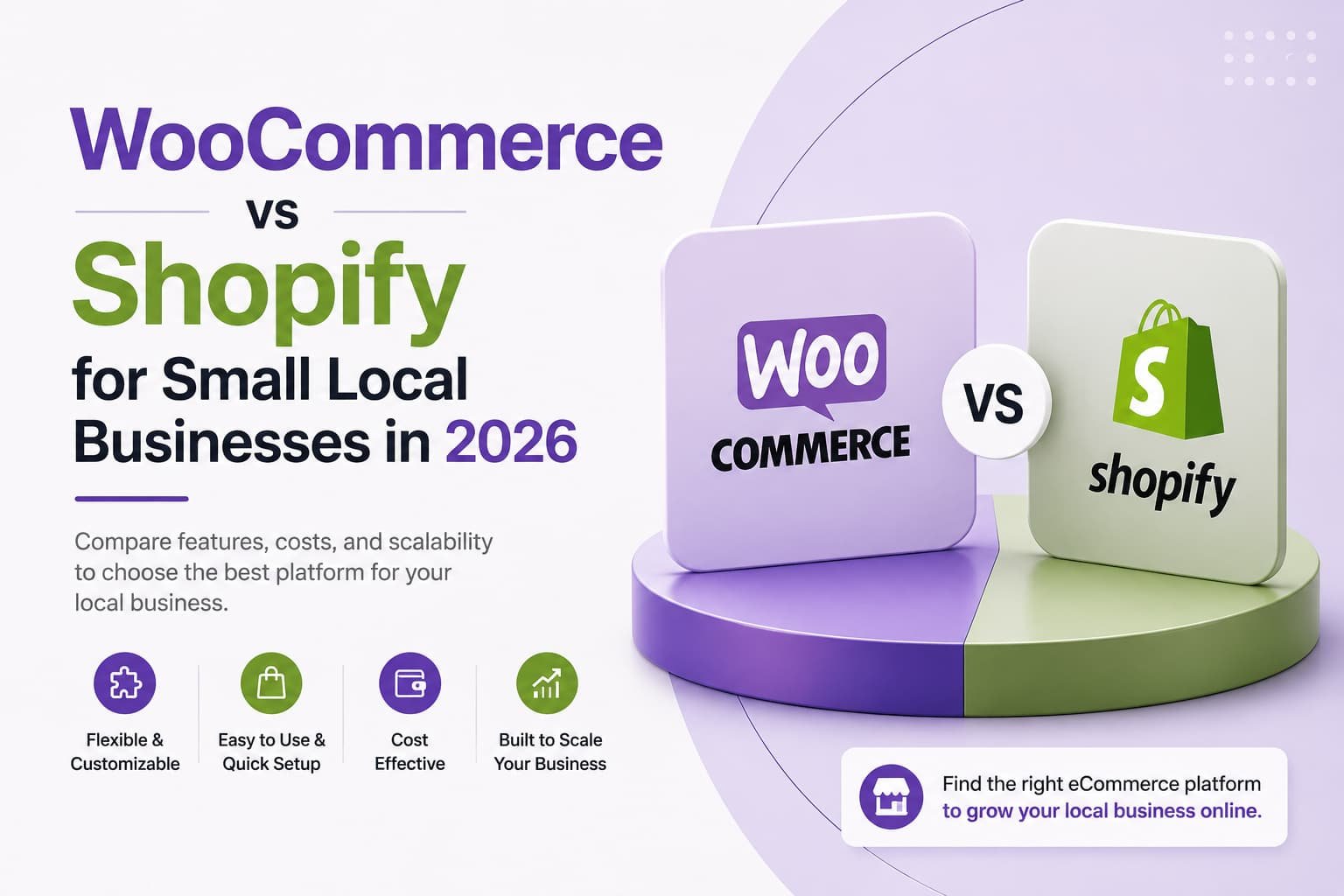
For most small local businesses, Shopify is the better fit if you want a working store fast and don’t want to manage hosting, security, or updates yourself, while WooCommerce is the better fit if you already run a WordPress site, want more control over the exact setup, and don’t mind a bit more hands-on maintenance in exchange for lower ongoing costs. Neither platform is universally “better.” They solve the same problem with opposite trade-offs: money versus time, and simplicity versus control.
If you’re a landscaper who wants to sell gift cards and branded gear, a pet groomer adding a small retail line of shampoos and leashes, or a pool builder selling maintenance kits and chemicals alongside your build services, you don’t need an enterprise platform. You need something that gets a clean, working store online without eating your week. This guide compares both platforms specifically through that lens, not through the lens of a large retailer trying to optimize checkout conversion rates at scale.
The Core Difference: Managed vs. Self-Assembled
Shopify is a fully hosted, managed platform. WooCommerce is a free plugin you add to a WordPress site, and you assemble the rest yourself.
With Shopify, you sign up, pick a plan, choose a theme, add products, and you’re live. Hosting, security patches, uptime, and PCI compliance are all handled behind the scenes. You’re renting a fully equipped storefront.
With WooCommerce, the core plugin is free and open source, but a working store requires you, or someone you hire, to choose a web host, install an SSL certificate, pick a theme, add the plugins you need for payments and shipping, and keep all of it updated over time. You’re buying the building and fitting it out yourself.
Neither approach is wrong. It depends on whether you’d rather pay more monthly for less hassle, or pay less monthly for more control and more responsibility.
What Each One Actually Costs
This is where the two platforms diverge most sharply, and it’s worth being specific instead of vague.
Shopify’s pricing is a straightforward monthly subscription. The Basic plan runs $39 a month (less if you pay annually), and covers what most small local businesses need: a real online store, product listings, basic reporting, and a couple of staff accounts. The Grow plan, at $105 a month, adds more staff logins, better shipping rates, and stronger analytics, useful once you’re managing real order volume. Advanced, at $399 a month, is built for businesses that need deeper reporting and lower transaction fees, more than most local service businesses will need early on. On top of the subscription, Shopify charges a transaction fee on every sale, typically around 2.9% plus 30 cents if you use Shopify’s own payment processing, with that rate improving slightly on higher tiers.
WooCommerce’s cost structure is the opposite: no subscription fee for the software itself, but a collection of smaller costs that add up. Realistic annual costs for hosting, a domain, a decent theme, and a handful of essential plugins commonly land somewhere between $500 and $3,000 a year for a small, well-run store, though a bare-bones setup can come in lower and a heavily customized one can run much higher. You’ll also pay payment processing fees through whichever gateway you connect, Stripe and PayPal both charge in the same general range as Shopify’s own rate, since WooCommerce itself doesn’t take a cut of your sales.
The honest summary: Shopify’s cost is predictable and higher. WooCommerce’s cost is variable and usually lower, but it takes more research to land there, and it’s easier to underestimate if you don’t already know what you’re doing.
Ease of Setup and Ongoing Maintenance
This is usually the deciding factor for a small local business owner who’s already running the actual business full-time.
Shopify is built for someone without technical experience to get a store live in a weekend. The theme editor is visual, the checkout is built in, and updates happen automatically in the background. You never have to think about server capacity or a plugin conflict breaking your checkout the week before a big sale.
WooCommerce has a real learning curve, or a real cost if you hire it out. You’re choosing a host, keeping WordPress core, your theme, and every plugin updated, and troubleshooting the inevitable plugin conflict yourself, or paying someone to. For a business owner who’s comfortable in WordPress already, or who has a developer on call, this isn’t a big deal. For someone who just wants to sell twenty products and get back to the actual work of running their business, it can become a second job.
If you already have a WordPress website for your business, and many local service businesses do, adding WooCommerce to it is a natural extension. If you’re starting from zero, that convenience doesn’t apply, and the calculation shifts toward Shopify.
Design and Customization
Both platforms can produce a genuinely good-looking store. The difference is in how you get there and how far you can push it.
Shopify’s theme store offers polished, professional designs out of the box, and its app ecosystem covers most common needs, reviews, loyalty programs, email marketing, without touching code. Customization beyond what a theme and its settings allow requires Shopify’s own coding language (Liquid) or a developer.
WooCommerce, because it’s built on WordPress, gives you more raw flexibility. If you want a store that’s tightly integrated with a content-heavy site, a blog, a portfolio, service pages, and a small shop all sharing one design system, WordPress and WooCommerce handle that more naturally than Shopify does. The trade-off is that achieving a polished result usually takes more setup work, whether that’s your own time or a developer’s.
For a business that’s primarily selling a handful of products alongside a service-focused website, this often tips toward WooCommerce. For a business that wants the store to be the main event and look sharp with minimal effort, it tips toward Shopify.
Which One Fits Your Business
A few patterns show up consistently.
Shopify tends to be the better fit if you’re starting from nothing and want to launch fast, you’d rather pay a predictable monthly fee than manage hosting and plugins yourself, you’re not particularly technical and don’t have a developer on retainer, or your product catalog is small to medium and fairly standard, gear, retail add-ons, gift cards, merchandise.
WooCommerce tends to be the better fit if you already have a WordPress website you’re happy with, you want your store closely integrated with service pages, blog content, and booking tools on the same site, you’re comfortable with WordPress or already work with someone who is, or keeping ongoing costs low matters more to you than saving setup time.
There’s a simple gut check that works for most local businesses: if the online store is a small addition to a service-first business, and you already have WordPress, lean WooCommerce. If e-commerce is a meaningful part of your revenue, or you’re building a site from scratch and want it working quickly without becoming your part-time job, lean Shopify.
What’s Changed Going Into 2026
Both platforms have evolved, and it’s worth knowing what’s new before you decide.
Shopify has been building out infrastructure for AI-driven shopping, letting customers discover and buy products through AI assistants and chat interfaces rather than only visiting a website directly. This is now built into Shopify’s standard plans rather than requiring extra setup, which matters if your customers increasingly ask AI tools for recommendations before they search Google.
WooCommerce’s ecosystem has kept expanding too, with a large and mature library of extensions covering nearly everything a small store needs, though the trade-off of assembling and maintaining that stack yourself hasn’t changed. It remains one of the most widely used e-commerce platforms in the world, precisely because of that flexibility.
Neither shift changes the fundamental decision. It’s still managed simplicity versus owned flexibility.